
Would you like to book a $1,300% gain on a one day low risk trade? I would. That would imply that you turned your $100,000 account into $1,400,000 in just one day. Do it couple times - and you are a billionaire. Sounds too good to be true? It is possible in a Twitterworld. In a real world.. not so much.
Last week I came across the following Tweet:
I see an excellent risk/reward trade right now:
Buy 1 S&P500 (ES Mini), Strike 2,840
Funded by:
Sell 2 S&P500 (ES Mini), Strike 2,870
Expiering tomorrow,
max gain is $31 at S&P 2870
You start loosing above S&P 2,900
Open for credit of +$1
Close tomorrow based on mkt moves pic.twitter.com/w7LwJcIMNM
— The C O N T R A R I A N (@ZeContrarian7) April 16, 2020
And the following followup the next day:
— The C O N T R A R I A N (@ZeContrarian7) April 17, 2020
1,300% return in one day??
This is how the trade looks in ONE software at the time of the opening:
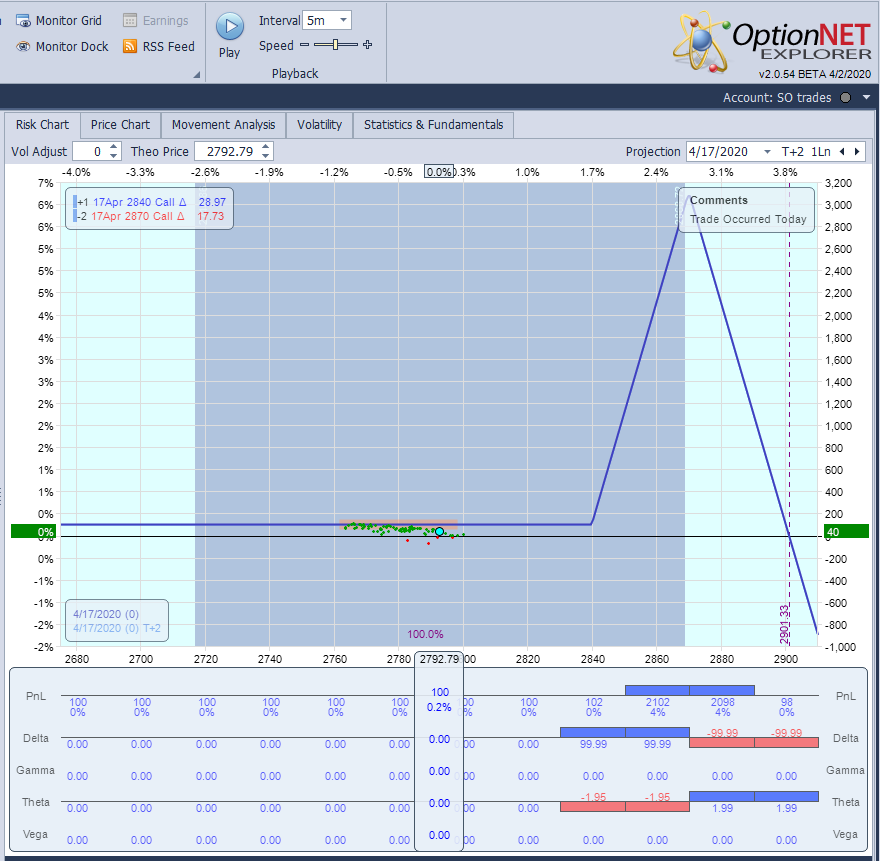
ONE shows a maximum return of only
7%. What is going on here?
This trade is long one call and short 2 calls. Which means one of the calls is naked and requires huge margin requirement.
If you are not a member yet, you can for answers to all your options questions
When the trade was closed on Apr.17, this is how it looked:
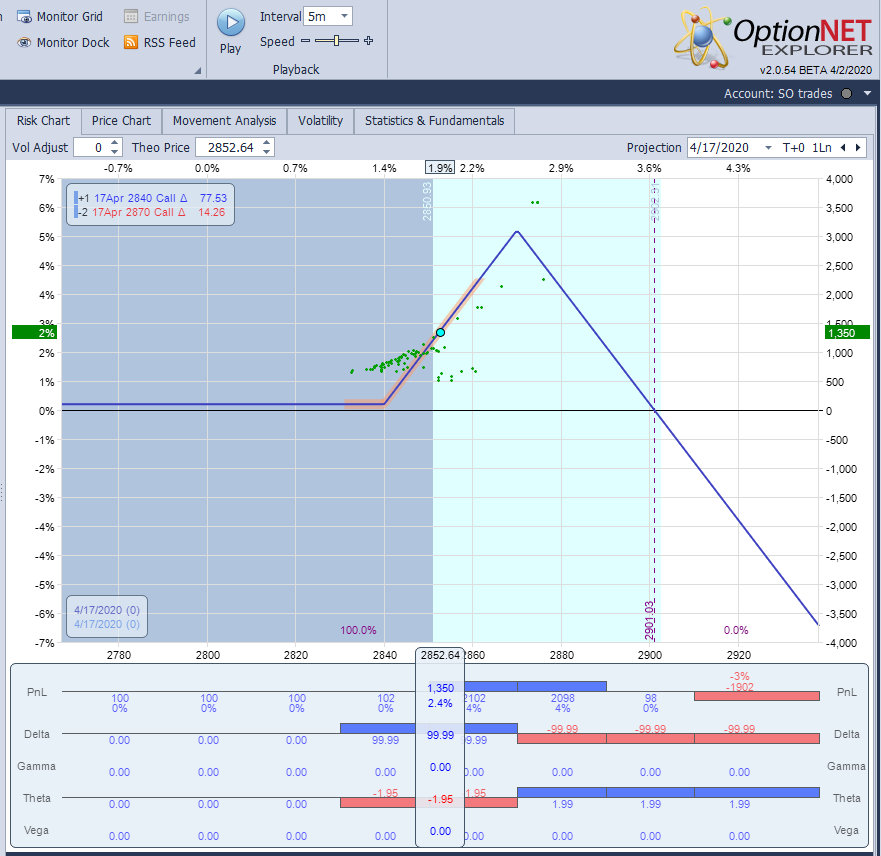
Explanation for "1,300% gain"?

This calculation ignores the margin requirement on the short options. When a trade requires a margin (like credit spreads or naked options), the return cannot be calculated on cash outcome - it has to account for margin requirement.
As a side note, it was a good trade. No downside risk, and upside risk starts at 2,900 (over 100 points move in one day). But the gain was nowhere near 1,300%.
What Is SteadyOptions?
Full Trading Plan
Complete Portfolio Approach
Diversified Options Strategies
Exclusive Community Forum
Steady And Consistent Gains
High Quality Education
Risk Management, Portfolio Size
Performance based on real fills
Non-directional Options Strategies
10-15 trade Ideas Per Month
Targets 5-7% Monthly Net Return
Recent Articles
Articles
Pricing Models and Volatility Problems
Most traders are aware of the volatility-related problem with the best-known option pricing model, Black-Scholes. The assumption under this model is that volatility remains constant over the entire remaining life of the option.
By Michael C. Thomsett, August 16

- Added byMichael C. Thomsett
- August 16
Option Arbitrage Risks
Options traders dealing in arbitrage might not appreciate the forms of risk they face. The typical arbitrage position is found in synthetic long or short stock. In these positions, the combined options act exactly like the underlying. This creates the arbitrage.
By Michael C. Thomsett, August 7
- Added byMichael C. Thomsett
- August 7
Why Haven't You Started Investing Yet?
You are probably aware that investment opportunities are great for building wealth. Whether you opt for stocks and shares, precious metals, forex trading, or something else besides, you could afford yourself financial freedom. But if you haven't dipped your toes into the world of investing yet, we have to ask ourselves why.
By Kim, August 7

- Added byKim
- August 7
Historical Drawdowns for Global Equity Portfolios
Globally diversified equity portfolios typically hold thousands of stocks across dozens of countries. This degree of diversification minimizes the risk of a single company, country, or sector. Because of this diversification, investors should be cautious about confusing temporary declines with permanent loss of capital like with single stocks.
By Jesse, August 6

- Added byJesse
- August 6
Types of Volatility
Are most options traders aware of five different types of volatility? Probably not. Most only deal with two types, historical and implied. All five types (historical, implied, future, forecast and seasonal), deserve some explanation and study.
By Michael C. Thomsett, August 1
- Added byMichael C. Thomsett
- August 1
The Performance Gap Between Large Growth and Small Value Stocks
Academic research suggests there are differences in expected returns among stocks over the long-term. Small companies with low fundamental valuations (Small Cap Value) have higher expected returns than big companies with high valuations (Large Cap Growth).
By Jesse, July 21
- Added byJesse
- July 21
How New Traders Can Use Trade Psychology To Succeed
People have been trying to figure out just what makes humans tick for hundreds of years. In some respects, we’ve come a long way, in others, we’ve barely scratched the surface. Like it or not, many industries take advantage of this knowledge to influence our behaviour and buying patterns.
- Added byKim
- July 21
A Reliable Reversal Signal
Options traders struggle constantly with the quest for reliable
By Michael C. Thomsett, July 20
- Added byMichael C. Thomsett
- July 20
Premium at Risk
Should options traders consider “premium at risk” when entering strategies? Most traders focus on calculated maximum profit or loss and breakeven price levels. But inefficiencies in option behavior, especially when close to expiration, make these basic calculations limited in value, and at times misleading.
By Michael C. Thomsett, July 13
- Added byMichael C. Thomsett
- July 13
Diversified Leveraged Anchor Performance
In our continued efforts to improve the Anchor strategy, in April of this year we began tracking a Diversified Leveraged Anchor strategy, under the theory that, over time, a diversified portfolio performs better than an undiversified portfolio in numerous metrics. Not only does overall performance tend to increase, but volatility and drawdowns tend to decrease: